Mitchell Anderson
Sonnet to Byron
2025
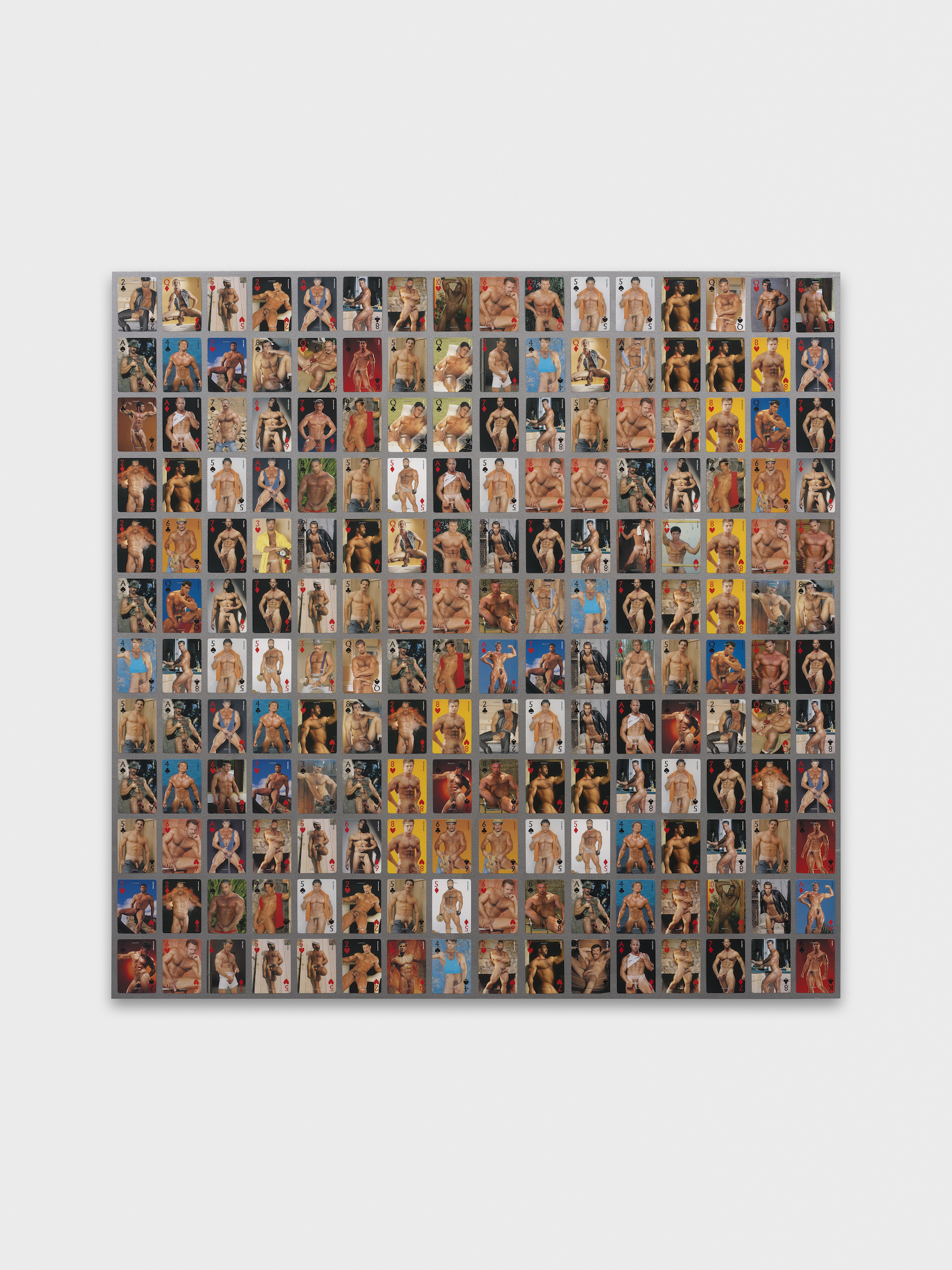
COLT Naked Muscles and COLT Hairy Chest playing cards, staples and dispersion on panel
119.8 x 119.4 x 5 cm (47 1/8 x 47 x 2 in)
Courtesy of the artist and Bernheim Gallery
Mitchell Anderson (b. 1985, Chicago) lives and works in Zurich, Switzerland. Anderson’s practice incorporates readymade objects or imagery relating to American culture.
In Anderson’s playing card series, developed over the last decade, each letter of the alphabet is assigned to a specific type of card and spells out poems and other texts in a structured grid. Sonnet to Byron encodes a sonnet in tribute to Lord Byron by English Romantic poet John Keats using a combination of found gay porn playing cards from the late 90s and early 2000s. Keats dedicated several sonnets to fellow poets— such as Edmund Spenser, Thomas Chatterton, and Lord Byron—praising their literary talent and acknowledging their influence on his own work. Anderson identifies the homoerotic undertones within these tributes and reimagines the modernist grid, employing organization as an act of pleasure and order as a form of enjoyment. Anderson relinquishes control over the final composition to the structure of the sonnet itself, allowing the text to dictate the arrangement of the cards, similar to certain conceptual strategies of the 1970s (e.g. Boetti’s biro and arazzi works), but inflected with humor and based in a mass media, everyday reality.
A standard 52-card deck of French-suited playing cards has 13 types of black cards (A – K) and 13 types of red cards, allowing a basic cipher comprising the 26 letters in the Roman alphabet. In totalitarian environments a deck of cards and a game of solitaire, played near a secret ally, allows an easy transfer of information. This cryptographical incidence coincides with others in the modern deck: like the possible use as an almanac (52 cards for 52 weeks, four suits for four seasons) and its representation of traditional Western class structure.
These are considered coincidences. For the past couple of years I have used a simple cipher to secrete texts composed of image-based playing cards penetratingly stapled like strident secular shrines onto panels. This grants two desirable aspects: the inclusion of the coded within a primary gridded visual and a perceived freedom from compositional choice. The texts, like the cards, are found and in them I find a preference, as with my earlier hidden text embroideries, for the elegiac and the energized from poetry and prose originating in both the classical and popular. Wool and Kruchenykh are equals here. I pair the texts with what has been left unsaid in the visual, almost always a collection of similar impressions of a subject over time. Those visuals arouse me in art as they do in life, whether physically or through imagined ideas of a communal iconic. This combination of the popular (or pop, I guess) with concrete poetry, sifted with a Dadaist freedom from the existential is a gratifying soup and I’m turned on by works which hold their cards close to their chest, revealing further to, or sharing a secret with, those who take the time to recognize and break their available codes.
Mitchell Anderson, January 2021
Provenance
Bernheim, London
Exhibitions
“Sonnet,” Bernheim, London, 27 February – 17 April 2025
See also