Derek Jarman
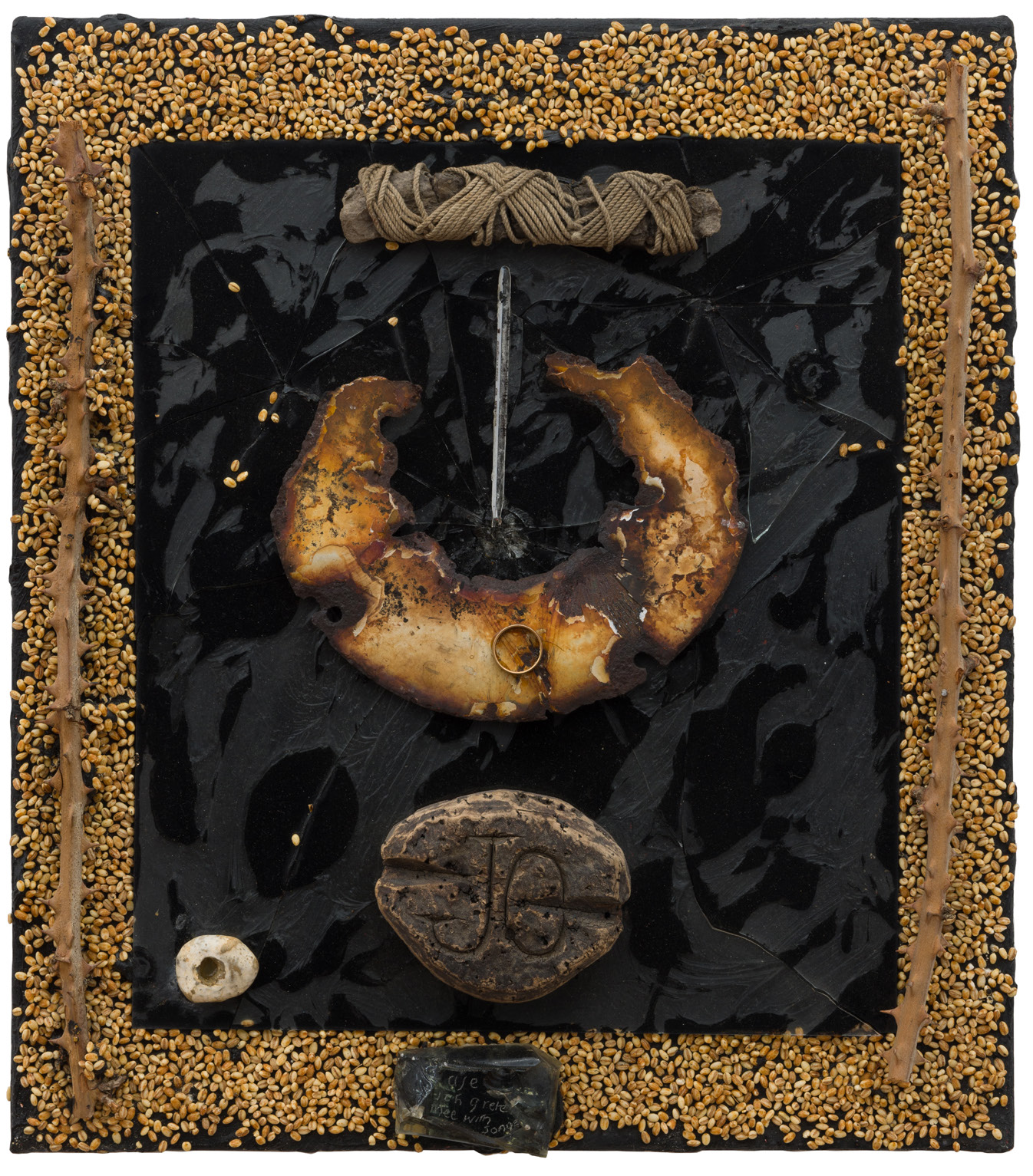
Ich grete thee with songe
1990
Oil and mixed media on canvas
18 1/8 x 16 in (46 x 40.64 cm)
Courtesy of Del Vaz Projects, Los Angeles
Derek Jarman (b. 1942, Northwood d. 1994, London) was an artist, filmmaker, actor, screenwriter, stage director, musician, and gay rights activist.
Ich grete thee with songe is part of Jarman’s black paintings series featuring found objects, often taken from the environment surrounding his beachside cottage in Dungeness, arranged in reliquary-like compositions on tar-black grounds. He often included “hag stones” in his black paintings, which were rocks with naturally forming holes with mystical properties and Celtic heritage. The “JC” carved on the hag stone double as Jesus Christ’s initials. The frame of seeds were seeds Jarman, an enthusiastic gardener, planted in his garden in Dungeness. Ich grete thee with songe translates to: “please accept my song even though I am an unworthy vessel.” Jarman was a reader of 17th century poetry, and had the lines of John Donne’s “The Sun Rising” inscribed on his cottage exterior.
A significant inspiration for the black paintings was the subject of alchemy which Jarman encountered in the course of his film research. Jarman became fascinated with alchemists such as John Dee, Parcelsus, Robert Flood, Edward Kelly, Agrippa, and Giordano Bruno. Writing about John Dee, Jarman describes being drawn by Dee’s “preoccupation with secrets and ciphers, why this obsession of the ritual of closed closets and the ritual of the sanctuary?” Jarman made several experimental super 8s around ideas of alchemy and the occult. Jarman also studied the work of Caravaggio for his film Caravaggio (1986), which took him eight years to finish, and was his next independent feature after his first film Sebastiane (1976). Jarman extracts much queer hagiography and Caravaggio’s use of tenebrism in his black paintings.
The black paintings also chronicle Jarman’s AIDS diagnosis, through which he eventually lost his eyesight, and his purchase of a cottage in Dungeness. After being diagnosed with HIV in 1986, he and Tilda Swinton went looking for things to film and discovered Prospect Cottage near the seashore in Dungeness which was painted black. Jarman called it “Chernobyl House” as acid rain was falling in the UK at the time, and a nuclear power station is closeby. He also saw fisherman patching their boats with tar. The black paintings become a talisman of the virus, symbolic of a black or diseased body. As Jarman would say, “I signed my paintings with thermometers.” And sometimes, he would include real thermometers in his paintings.
All objects in the black paintings are found in the nearby environment or the beach and Jarman would smash the glass on the surface of the painting with a jewelry hammer. The paintings are symbols of a broken body, composed of detritus but transformed, via artistic alchemy into a more transcendent, spiritual form.
Jarman was a strong gays rights advocate and for those living with AIDS. Together with Peter Tatchell and Jimmy Somerville, he founded the direct action group OutRage! in 1990. He became a member of the Gay Liberation Front and participated in the debates and dialogues within ACT UP.
Provenance
Del Vaz Projects, Los Angeles
Exhibitions
See also
Derek Jarman at Amanda Wilkinson Gallery
“Derek Jarman’s Capacious Monochrome,” Frieze, Connor Sinnott, August 26, 2025
Derek Jarman monograph, 1986-1993
Derek Jarman’s The Garden (1991) at the Pinault Collection
“Derek Jarman: 1942-1994: A Political Death,” Simon Whatney, Artforum, Vol. 32, Issue 9, May 1994